
Introduction to the Documentary
Tonight, I’m going to show you a documentary that our television department has prepared on Thailand is primarily about the king and queen of Thailand and the title of it is more than a monarch. The BBC of London had made a documentary of Thailand, and the king and queen were very much disappointed in it. They weren’t pleased with it at all, and they gave our television people full latitude to go anywhere. I think they even provided military helicopters for them to go wherever they needed, and they were very courteous to us and I think they appreciate what we’ve been doing for them.
Incidentally, the Queen of Thailand is—at least it’s official as of this time—that she will be here for eight days in March. She will be a guest here for eight days. She’ll be our guest. Now, we’ve never had a reigning king or queen on our campus. We’ve had a king here before, but he had by that time abdicated and was no longer actually reigning. And that was of course King Leopold III of Belgium, who died just about a year ago now.
But this will be the first time we’ve had a reigning royal personage on the campus that is going to concern the United States government and giving her security and protection. And we’ll have to work it out with the State Department. And it’s really going to be quite a project. She’s going to bring quite a little entourage with her. I think there will be 30 or 40 others with her. So, I hope she may speak to you and that you may of you see her. She is going to speak from this platform at least once and I think she is going to have an exhibit here while she is here.
After we saw this documentary, we were very much impressed that this gave us quite an insight into what we’re all going to have to be doing in the millennium. At the beginning of the millennium, we’re going to find much of the world in the same condition that this king and queen found so many of their population in the highlands. The hill tribes who are nomads and they don’t live in permanent homes. They’re absolutely uneducated. They have no knowledge whatsoever. That is no education. And you’ll see a great deal about it in the film and how the king and the queen work with them and help them. And it does give us a little insight into what we’re going to have to do in the millennium.
I want to say a few words after it doesn’t last the full hour and a half. I’ll have a chance to come back and say a few words after you’ve seen the film.
Opening Scenes of Bangkok and the Grand Palace
The following is an Ambassador Foundation presentation. Bangkok (กรุงเทพฯ), capital city of the Kingdom of Thailand, a teeming city of 5 million people. The sidewalks are crowded with shoppers and vendors. Ancient and modern, east and west, mix easily in the busy streets. The mighty Chao Phraya River, bustling with ferries, rice barges, and the merchant ships of all nations, connect, bustling with fairies, rice barges, and the merchant ships of all nations, connects Bangkok (กรุงเทพฯ) to the Gulf of Thailand.
In this city that was once known as the Venice of the East, the old canals are now being filled in to make way for new roads, modern arteries of a modern city. In the last half of the 20th century, Bangkok (กรุงเทพฯ) has become a crossroad of Asia and one of the great cities of the world. It is the pulsating heart of Thailand today. But at the heart of this city with its traditional architecture as a striking contrast to the new buildings is the Grand Palace of the Thai Kings.
The carefully restored and lovingly cared for halls and temples are a reminder of another time. The hectic pace of modern Bangkok (กรุงเทพฯ) seems far away. Visitors marvel at the ornate buildings, intricate carvings, and gilded spires and pagodas that bring to life the long and colorful history of the Siamese or Thai people. But the Grand Palace is more than a monument to Thailand’s past. It also stands as a symbol of the nation’s present and its future.
Coronation of King Bhumibol and His Role in Modern Thailand
May 5th, 1950, young Prince Bhumibol Adulyadej (ภูมิพลอดุลยเดช) is crowned Rama IX in the Grand Palace at Bangkok (กรุงเทพฯ). He places the crown upon his head and makes the first official pronouncement of his reign: “We shall reign with righteousness for the benefit and happiness of the Siamese people.” The people greeted the new king and his beautiful young queen with love and respect.
In 1950, while much of Southeast Asia was convulsed in civil war and revolution, the people of Thailand had remained unswerving in their loyalty and affection to their monarch. The Thai throne had remained a stable and unifying institution in the turbulent and changing world of Asia after World War II. King Bhumibol Adulyadej (ภูมิพลอดุลยเดช) still reigns in Thailand. Every year the entire nation celebrates his birthday as its national day.
At the Royal Plaza in Bangkok (กรุงเทพฯ), the king reviews the regiments of the royal guards in the ceremony of Trooping the Colors. As the ranks of the elite royal regiments march by the review stand, led by their commanding officer, Crown Prince Vajiralongkorn (วชิราลงกรณ), they salute the king and queen. King Bhumibol Adulyadej (ภูมิพลอดุลยเดช) is an active constitutional monarch.
The king, Queen Sirikit (สิริกิติ์), and their children—Crown Prince Vajiralongkorn (วชิราลงกรณ), Princess Maha Chakri Sirindhorn (มหาจักรีสิรินธร), Princess Chulabhorn Walailak (จุฬาภรณวลัยลักษณ์)—and King Bhumibol Adulyadej (ภูมิพลอดุลยเดช)’s mother, Queen Mother Sri Savarindira (ศรีสวรินทิรา), along with many other members of the royal family, play a very active role in their nation’s affairs, not only in ceremonial affairs of state but in practical acts of service that touch the lives of all Thai people.
History of the Chakri Dynasty and Thailand’s Modernization
There exists a very special relationship between the monarchy and the people of Thailand. The Thai have always honored their kings, but the nine kings of the House of Chakri hold a very special place in the hearts of their people and in the history of Thailand. Until the middle of the 18th century, the capital of Thailand was Ayutthaya (อยุธยา). Great and powerful kings ruled here. Ayutthaya (อยุธยา) was widely renowned as a commercial and cultural center. European traders wrote home reports that this was the most beautiful city in the East.
However, in 1767, during a period of internal strife, Ayutthaya (อยุธยา) fell to an invading army. It was a serious setback to the Thai people. But within 10 months, the Thais rallied under a new leader, King Taksin (ตากสิน) the Great, who pushed the invaders back and recaptured Ayutthaya (อยุธยา). But the once-proud city was now a charred ruin, a desolate, empty shell.
After the death of King Taksin (ตากสิน) in 1782, the crown was offered to a popular hero, General Chakri (จักรี). General Chakri (จักรี) became known as King Rama I. He established a new capital for the nation at Bangkok (กรุงเทพฯ), then just a small village on the Chao Phraya River. Rama I set about to make Bangkok (กรุงเทพฯ) a city that would restore to his people the splendor that was once Ayutthaya (อยุธยา). Although he had to spend much of his reign battling his nation’s enemies, he also determined to preserve the ancient heritage that so nearly perished in the destruction of Ayutthaya (อยุธยา). He reorganized the old laws and reestablished the Buddhist faith and literature.
When the old warrior king died in 1809, he had made great strides toward restoring his nation’s morale and setting it back on the path of progress. His son Rama II and grandson Rama III followed him to the throne. During their reigns, Thai music, literature, and the other fine arts continued to flourish. Strong trading links were reestablished with other Asian and European powers, making the country rich and prosperous.
Kings Mongkut and Chulalongkorn: Reformers and Modernizers
When Rama III died, the crown passed to his younger brother, Prince Mongkut, who became Rama IV. King Mongkut (มงกุฎ) was self-trained as a scientist and a scholar. He learned English and Latin from a missionary and encouraged the children of the courtier to become familiar with Western ways. During this period, the neighboring nations of Thailand became colonies of the European empires. But largely because of the diplomacy of King Mongkut (มงกุฎ), the ties were able to preserve their freedom.
After King Mongkut (มงกุฎ)’s death, his eldest son, Prince Chulalongkorn (จุฬาลงกรณ์), was crowned Rama V and reigned until 1910. He was to have a great impact on Thailand’s future. He traveled extensively in Asia and Europe, and from these travels formed ideas for modernizing his nation. He reorganized the educational system and sent his sons to study abroad and establish personal contacts with the crowned heads of Europe. He also organized the infrastructure of a modern state, including Thailand’s first railroad, telegraph, and postal system.
King Chulalongkorn (จุฬาลงกรณ์) also began the practice of traveling to all parts of Thailand to see for himself the condition of his people. Often traveling incognito, he made many journeys to remote areas, gaining firsthand knowledge and experience. By the time King Chulalongkorn (จุฬาลงกรณ์) died in 1910, he had led Thailand wisely into the 20th century.
Rama VI, Rama VII, and the Birth of Constitutional Monarchy
His son Rama VI continued to modernize Thailand during his 15-year reign. He was succeeded by his youngest brother, Prince Prajadhipok (ประชาธิปก), who immediately began to lay down the foundations of democratic government. In 1932 as Rama VII, he promulgated a new constitution and thereby changed his position to a constitutional monarch.
Due to failing health, he abdicated in 1935. His 10-year-old nephew, Prince Ananda Mahidol (อานันทมหิดล), was next in line. This popular young king’s reign was cut short by his untimely death in 1946. He was succeeded by his younger brother, Prince Bhumibol Adulyadej (ภูมิพลอดุลยเดช).
Early Life of King Bhumibol and His Return to Thailand
Prince Bhumibol was born in 1927 in Cambridge, Massachusetts in the United States of America while his father was studying public health at Harvard University. He is the only reigning monarch ever to be born on American soil. After ascending the throne in 1946, the young king continued his education in Switzerland.
He married Mom Rajawongse Sirikit Kitiyakara (สิริกิติ์ กิติยากร) one week before his official coronation in 1950. The royal couple returned once more to Switzerland to continue their preparation for a life of service to their people.
As Rama IX, King Bhumibol Adulyadej (ภูมิพลอดุลยเดช) followed in the tradition of the great Chakri kings. Each of the kings had shown great foresight in understanding how to use his position to best serve the Thai people and build the nation. King Bhumibol Adulyadej (ภูมิพลอดุลยเดช) Rama IX was no exception anyway.
Thailand’s Rural Challenges and the King’s National Development Vision
In 1952 he visited the northeast provinces of Thailand for the first time. As he talked to the people in the villages, he gained insight into the needs of the farmers. He then realized that the urgent task of his reign would be to strengthen the rural people. Away from the urban sprawl of Bangkok (กรุงเทพฯ), Thailand is still a rural nation. Over 80% of Thailand’s 50 million population are farmers.
Agriculture is the backbone of the economy. Thailand is among the world’s major exporters of rice, tapioca, and rubber. But many of these hardworking families are not yet able to fully share in their nation’s growing prosperity. Although Thailand does not have the desperate poverty that blights some other developing countries, many families lack adequate education and training. Some are landless and deeply in debt.
The rural people live as they always have, planting and harvesting their crops and looking to the land to supply their basic needs. But they cannot stand still in a changing world. Even the most remote corners of Thailand have begun to feel the impact of the 20th century. The rural people are conservative and slow to change. They are often unwilling to take advantage of modern agricultural techniques that would improve their crop yields and allow them to fully participate in Thailand’s development.
As King Bhumibol Adulyadej (ภูมิพลอดุลยเดช) recognized the needs of the rural people, he realized that the way to help was not to undermine the conservative rhythm of Thai life. However, even though the rural people might be suspicious of change, they would trust their king. To them, King Bhumibol Adulyadej (ภูมิพลอดุลยเดช) was the focal point of all that is Thai—the language, religion, even the land itself. They would trust him to lead them along the right path of progress.
And so the king and queen with other members of the royal family have continued the tradition begun by the great King Chulalongkorn (จุฬาลงกรณ์), traveling thousands of miles every year to all parts of their kingdom, helping Thailand’s rural population build a secure and prosperous future.
Royal Development Projects: Irrigation, Agriculture, and Innovation
From King Bhumibol Adulyadej (ภูมิพลอดุลยเดช)’s desire to help the rural farmer has come the outstanding achievement of his reign. Hundreds of local development projects undertaken through Royal Initiative. Here in the north of Thailand, a new dam has been completed, enclosing a reservoir for irrigation. The king had encouraged this reservoir to be built knowing that a regular water supply will greatly increase the productivity of the local farmland.
Now it is finished and King Bhumibol Adulyadej (ภูมิพลอดุลยเดช) and Queen Sirikit (สิริกิติ์) have come with their daughter Princess Maha Chakri Sirindhorn (มหาจักรีสิรินธร) for a personal inspection. It is to be more than just a ceremonial visit. They have come to release over 100,000 small fish and freshwater prawns into the waters of the new reservoir. The fish will breed and once the reservoir is fully stocked, the people will have a valuable additional source of protein, adding to the benefit that the irrigation waters will bring.
This reservoir is not large, but it will have a great impact on the life of this part of the kingdom. Their majesty’s personal involvement has impressed on the local people the benefit the new development will bring. The king works together with the government officials and the people to develop the country. Each one of the development projects is designed to serve the needs of a particular area.
The agricultural research and development center at Khao Hin Son (เขาหินซ้อน) is located on land that was originally donated to the king to be used as a site for a palace. But King Bhumibol Adulyadej (ภูมิพลอดุลยเดช) realized that this land at Khao Hin Son (เขาหินซ้อน) occupied an important position on the edge of the central plane. He decided that the land would be better used to establish a research and development center specifically to help solve the problems facing farmers of the area.
This potentially fertile and productive part of the country is in danger of becoming a wasteland. The rainfall is adequate, but the lack of natural catchment areas makes water and soil conservation important. Without skillful management, the soil dries out and becomes depleted. The local farmers didn’t know how to take advantage of the lie of the land when plowing to increase water catchment. The easy to grow cassava plant from which tapioca is derived was the only crop to be cultivated. Cassava is an undemanding plant from the farmer’s point of view, but it rapidly depletes the soil of nutrients.
At the research station at Khao Hin Son (เขาหินซ้อน), many experiments are in progress to show local farmers how water catchment, storage, and irrigation techniques can preserve the productivity of the land. Farmers are taught to sew a crop of peanuts after each crop of cassava. The peanuts restore nitrogen to the soil and help maintain its fertility. Once a supply of water is assured, fruit trees can be cultivated.
The lessons learned at Khao Hin Son (เขาหินซ้อน) are passed on to local farmers through an extension program. They are encouraged to form cooperatives. By pooling their resources, the community can soon become self-reliant and self-supporting. Around Khao Hin Son (เขาหินซ้อน), other dams and irrigation canals have been established, and this area is now able to produce a much greater variety of crops. As more farmers take advantage of the extension program, their prosperity increases and the future of the region is assured.
Many of the projects undertaken through royal initiative begin here at the Chitralada Villa. Residents of the royal family when they are in apart from the formal gardens the grounds have been given over to agricultural projects. The king has in effect established an experimental farm in the heart of the nation’s capital. The stable can accommodate about 50 milking cows. As new breeds are introduced, careful records must be kept to learn how the cows adapt to conditions in Thailand.
A pasteurizer, a powdered milk plant, and the milk packaging machine are an impressive demonstration of how farmers can form cooperatives to purchase the equipment with which to process their surplus supplies. The rice mill and warehouse demonstrate economical methods of preparing and storing this vital food. The king has been particularly interested in demonstrating alternate methods of milling rice so that valuable nutrients and vitamins are not lost.
Innovative engineering ideas such as this seesaw pump designed to turn otherwise wasted energy into useful work always find a place for testing and demonstration at Chitralada. Typical of the experiments carried out at Chitralada is this husk grinding and compressing project. The waste material from rice milling when subjected to heat and pressure can be molded into logs which can then be used as a substitute for firewood.
New varieties of fish suitable for stocking Thailand’s inland waters are bred in these ponds. Several acres of the palace grounds have been plowed. New strains of rice and other crops are then tested before being made available to farmers around the country. Many government officials, farmers, students, and school children visit the projects at the Chitralada farm every year.
The farmers are impressed with the practical ideas and solutions to everyday problems in rural areas. Yet, it is probably their king’s personal involvement, such as his decision to conduct the experiments on the grounds of his own residence, that inspires them to take the ideas home and put them into action.
Deforestation, the Golden Triangle, and the Hill Tribe Crisis
One of the most serious problems facing Thailand is the destruction of the forests that cover the mountain ranges. These vast forests are vital to the protection of wildlife and the preservation of the whed. When trees and thick undergrowth cover these areas, precious moisture from rainfall is released gradually into the rivers and streams that flow down to the lowlands. But if the trees are felled, the water is released in sudden floods that erode the mountain sides and inundate the plains below.
For many years, Thailand has been suffering rapid deforestation. Much damage is done by illegal log poachers who indiscriminately fell the great teak trees for quick profit. Additional damage is done unintentionally by the hill tribes that live in the northern highlands. For generations, they have roamed this rugged country, having little contact with the lowland people, choosing to maintain their own language and customs.
They practice a wasteful form of agriculture known as slash and burn. The forest is cleared and the trees are burned. The clearing is then used to plant the hill tribe’s main cash crop, the opium poppy. This area of the world which Thailand shares with Laos and Burma has become known as the Golden Triangle. From the income derived from raw opium that is cultivated here every year. But not much of the profits from the illicit opium trade filters down to the hill tribe people who remain poor.
As the poppies are growing, the score the seed pod several times. They then collect the seeping resin from which the opium is extracted. When after about 5 years the poppy fields lose their fertility, the tribes move elsewhere, repeating their cycle of destruction. So although these hill tribes are only a small minority of Thailand’s population, this nomadic way of life has caused considerable damage. From their limited perspective, they cannot see the damage they are doing.
King Bhumibol Adulyadej (ภูมิพลอดุลยเดช) has understood the importance of winning the confidence and cooperation of the hill tribes if the northern forests are to be saved. He has given his enthusiastic support to projects designed to help them learn a more settled way of life.
Many reforestation projects are underway in the hills and mountains around Chiang Mai (เชียงใหม่). Volunteer workers from the hill tribes assist with the projects. They settle in the deforested regions, planting and cultivating thousands of saplings of fast-growing species. The little trees become established and soon these barren hills will be covered with new growth. The king recommends a variety of trees be planted. fruit trees, soft and hard woods, and bamboo.
At the Pang Da (ปางดะ) Highland Agricultural Research Station in Samoeng (สะเมิง) District, research is carried out to introduce cereals, fruits, and vegetables. In this picturesque valley, the hill tribesmen see that cash crops previously unknown to them can be grown effectively in the mountains. Wheat, barley, and other cereals have been planted and the development carefully monitored. Strawberries and grapes are grown alongside traditional fruits and vegetables.
Many other crops are tried, including cucumbers, beans, and coffee. Some adapt easily to the mountain environment. Others need more care. Fruit trees are planted and grafting experiments conducted to determine which varieties do well. Practical scientific research combines with the Tai’s love of nature to give the project at Pang Da (ปางดะ) a park-like setting.
Cultural Preservation and the Royal Family’s Support of Thai Arts
Many similar stations have been established in districts that were formerly devoted to opium cultivation. They show the hill people that there is an alternative to their nomadic existence. Through the King’s initiative, many reservoirs have been built. With a steady water supply, fields can be irrigated and crop yields increased.
Most of their majesty’s projects are small in scale but have far-reaching effects on the lives of the people. This hydroelectric plant harnesses water from the dam on its way to the fields. The small unit just 10 kow brings to this remote village the previously unimagined luxury of electric light. Once the hill tribes begin to pursue a more settled form of existence, schools can be established and the children educated to take their place in Thai society.
But not all the mountain people are convinced of the benefits of the crop substitution programs. They are not easily persuaded to abandon the habits of a lifetime. At Ki, close to the Burmese border, representatives of several tribal groups wait in the morning sun. This is the day that could change their lives and the lives of their people forever.
The farmers of Ki are opium growers. The scanty crops from their irrigated rice fields cannot support their needs. To survive, they depend on the poppy cash crop. So far, they have not been eager to participate in the crop substitution programs. But now they wait for a special visitor. His Majesty King Bhumibol Adulyadej (ภูมิพลอดุลยเดช) is coming himself to visit with them, to listen to them, and see what can be done to help them break out of the vicious cycle that is keeping them and their people poor.
After greeting local officials, the king accompanied by Princess Maha Chakri Sirindhorn (มหาจักรีสิรินธร) meets the tribal leaders. He listens carefully. The leaders explain that they’re willing to stop growing the opium poppy, but first they must know how they will survive. Unless they have more water, they cannot grow enough rice. The existing water supply is insufficient to support them without the income they get from growing opium.
The king always prepares thoroughly for a visit. He has studied this area. He has with him a detailed map that he has carefully marked. He has noticed that there are two possible sites for a reservoir. One is some distance away down the hillside in a rather inaccessible spot. The engineers do not favor it. They could only build a small weir that will not hold much water.
A much better site has been found. This valley could be blocked and the resulting reservoir would hold enough water for the tribe’s people for the foreseeable future. But the hill tribesmen do not seem enthusiastic about this. The king decides to see both locations.
After a strenuous walk along the rough trails, the royal party arrives at the site with the irrigation engineers. They discuss the advantages and disadvantages. Now the king leads the party back to the main road and onto the alternative location that has been proposed by the engineers. This area has already been carefully surveyed with proposed water levels marked and indicated with signs.
The site is definitely preferable, but a dam placed here would flood much of the land that the hill tribes already have under cultivation. The king confers again with tribal leaders. First, they are nervous. But as the king wins their confidence, they begin to explain their worries. How will they be able to support themselves if their fields are flooded?
These simple people have no experience of marketing a cash crop. The opium dealers pay them poorly for their opium. But if they abandon opium for fruit and vegetables, how will they get them to market? and who will buy them. After listening carefully to all sides of the discussion, the king recommends to his engineers that they look again at the lower, more difficult site.
Once the local people feel the benefit of this settled way of life, he explains they will ask for the larger dam and more water. It is better to go slowly so that permanent progress will be made. The engineers have learned to trust the king’s judgment in these matters. His training and his 30 years of practical experience working with the people have given him the insight into the best way to resolve this kind of situation.
The king and his daughter mix with the local people. They accept their simple gifts. A fruit, some vegetables, a piece of traditional embroidered cloth, even a puppy. They stay talking to the people until late in the afternoon.
Meanwhile, the Royal Medical Unit that usually accompanies the king on these visits has also been busy dispensing advice and medication. It has been a hard but rewarding day for everyone. As the king prepares to leave, the people are reassured. They know that they have a friend in their king. A friend who really does care about them.
While both King Bhumibol Adulyadej (ภูมิพลอดุลยเดช) and Queen Sirikit (สิริกิติ์) have devoted much of their lives to helping the rural people take their place in the modern world, they have also encouraged them to maintain a respect for their traditions and cultural heritage. The graceful movements and ornate costumes of traditional Thai dancing are carefully preserved in modern Thailand.
Professional and non-professional dance troops alike devote their time and talents performing these classical dances which reflect the traditions of the past. The royal family have been keen patrons of both Thai music and art. Like her husband, Queen Sirikit (สิริกิติ์) realizes the influence her example can have on the people. She has chosen to wear distinctive styles made from traditional Thai materials.
Through her example, the leading ladies of Thailand have gained a new appreciation for the silks and other fine fabrics of their native land. The preservation of Thai handicrafts has become a special interest for the queen. She accompanies the king on his visits to all parts of Thailand. Wherever she goes, she asks to see the handicrafts of the region.
Every part of Thailand has unique handicrafts made from the indigenous materials. The people eagerly show the queen the things they have made. Her majesty examines a piece carefully. The rural people are generally skillful and talented, but sometimes the workmanship is not yet of the highest quality. The queen encourages the people to produce only the best and to take pride in preserving the time-honored designs and techniques which are in danger of dying out.
The Support Foundation and Revival of Traditional Thai Handicrafts
Queen Sirikit (สิริกิติ์) realized some years ago that her interest high handicraft had given her a unique opportunity to help the poor to earn an income while building their confidence and self-respect. In 1976, Her Majesty organized the foundation for the promotion of supplementary occupations and related techniques known as the support foundation.
Through support, Queen Sirikit (สิริกิติ์) has discovered a way to combine her interest in reviving and preserving Thailand’s traditional handicrafts with her deep desire to help the poor. Good morning. Good morning. Her Majesty can offer practical help to many of the poor, handicapped, and landless people she meets on the royal visits. Outside the village of San Pa Bong (สันป่าบง), a crowd of several thousand is gathered. In spite of the hot sun, they wait patiently in eager anticipation of the visit from the king and queen.
They arrive with Princess Maha Chakri Siradon. After greeting local officials, they begin to meet the people. These sisters are aged 101 and 108. They were born during the reign of King Chula Long. Now they meet King Bhumibol Adulyadej (ภูมิพลอดุลยเดช) for the first time. Some of the waiting people have some very urgent needs and they are looking to the royal family for help.
The queen’s staff go ahead to seek out those who have come for assistance. Sometimes a paper with their needs has been pinned to their clothing. Everyone is treated with compassion and respect. A number of people need medical care. The queen asks that they be taken to an area where the team of volunteer doctors are helping those in need of attention.
This little boy has been born without arms and legs. The family is poor and has no money or facilities to help him. He will be condemned to the life of a helpless [ __ ] unless some aid can be given. I do like that. The queen urges his mother to come to the support workshop. The skills she will learn will increase her income to help with her baby’s education.
As King Bhumibol Adulyadej (ภูมิพลอดุลยเดช) discusses an agricultural project with tribal leaders, Queen Sirikit (สิริกิติ์) and her daughter continue to talk with the people. Mimi No one is unimportant. No one must feel left out. Some men and women are landless, yet have several children to support. Many of the older children hope to go to a support workshop and learn a skill to supplement the family income. Her majesty takes careful notes so that later arrangements can be made.
Workshops have been established where the poor and landless can go for a period of training. These workshops are often located in the grounds of the royal residences like the beautiful Phuping Palace (พระตำหนักภูพิงคราชนิเวศน์) at Chiang Mai (เชียงใหม่). The royal family used Phuping Palace (พระตำหนักภูพิงคราชนิเวศน์) for two months every year as a base to visit the towns and villages of the north.
When in residence, Queen Sirikit (สิริกิติ์)’s youngest daughter, Princess Chulo, spends several hours each day personally supervising the workshop’s activities. This was a dying art because well, no one makes anymore. But my mother found very good shape of bag of my great grandmother 100 years ago and it still looks beautiful. So, she tries to revive the old art. We’ve done this for 10 years already.
Poor people from some of the northern provinces spend several months learning the traditional skills under qualified teachers. These trainees are being taught the art of making realistic artificial flowers. These men are learning the silver smith’s art. They progress from the simple stages to complex designs. Many of the workers reach a remarkable degree of skill.
Even though this young lady is handicapped, she has overcome her physical disability to the extent that she is now a master weaver, able to produce top quality work and to teach others the skills that she has learned. After a period of training, many of the workers can return to their village where they can continue the trade that they have learned. Some, however, like this silver smith become master craftsmen in their new trades.
Through the support foundation, they have developed their talents producing works of art in the great tradition of fine Thai craftsmanship. Heat. Heat. The main training center for the support foundation’s activities is located at Bang Sai (บางไทร), 30 mi north of Bangkok (กรุงเทพฯ) near Thailand’s old capital of Ayutthaya (อยุธยา). Landless families have been allowed to settle here. They are given a home and enough land to support themselves.
At Bang Sai (บางไทร), many poor families have been given a fresh start. Hundreds of young people from poor farming families are paid a small allowance while undergoing a training course in vocational and handicraft skills. The woodworking shop is popular. During the training course, the students learn to combine power tools with hand craftsmanship.
All students are encouraged to make useful articles of furniture. Standards are high. Careless work is not accepted. Each trainee is encouraged to be satisfied with nothing but his best. For the unskilled who have never made anything of quality before, it can be a struggle. But those who persist reach their goal and have the satisfaction of attaching to the work of their own hands the support foundation’s emblem, the symbol of quality.
Products that reach this level of excellence are sold in the exclusive Chitladash shops established at the initiative of her majesty to provide a means of marketing the crafts produced through the support foundation. In another section of Bang Sai (บางไทร), students learn the steps in casting bronze sculptures. In this method known as lost wax casting, an original sculpture is made by the artist.
Liquid rubber is then poured over the sculpture to form a flexible mold. This mold is now filled with wax. When the wax has hardened, the mold is peeled off and the wax form is encased in clay. When the clay is baked to harden it, the wax runs out, leaving the impression of the sculpture inside the mold. Molten bronze is now poured into the mold.
After the metal has cooled, the clay is chipped away to reveal a rough bronze casting. This is now finished and polished by the artist to produce a fine work of art identical in every detail to the original sculpture. These students are learning the elements of Thai design. First, a traditional motif must be faithfully copied. Next, the student produces an original.
Finally, the traditional and original are combined in a unique design. The student has learned how to link person creativity with the nation’s cultural heritage. One of the most important ancient crafts being revived through the support foundation is Yan Leau fernvine basketry.
The Leau vine grows abundantly in southern Thailand. The stem of the vine is extremely tough and can be woven into baskets that will hold their shapes and literally last for hundreds of years. A skillfully woven Yan Leau basket is a genuine work of art of lasting value and beauty. This handbag belonged to the queen of King Rama V. It is still in excellent condition although over a century old.
Master Craftsmanship and Preservation of Ancient Techniques
Selected lengths of the cut vine are drawn through a sharp-sided hole in a tin plate until they are of uniform size. The size of the hole determines the diameter of the strand. The smaller molds produce a finer, more pliable strand which enables more intricate work to be done. Weaving Yan La Pao basketry is a long process. To complete a handbag can take a skilled weaver several months.
This basket is woven around a wicker frame of the required size and shape. With simple tools and endless patience, the exquisite basket work slowly takes shape. Her Majesty is a great admirer of Yan Leau handbags and has been instrumental in helping many fashionable ladies rediscover the pleasure of owning an article of the finest high craftsmanship.
The many examples of fine craftsmanship created by the skilled workers of the support foundation confirm her majesty’s vision in helping the people revive their ancient skills. Through the support foundation, craftsmen have the opportunity to produce articles in the honored tradition of Thai quality. Ancient skills that were in danger of dying out are being revived and even elevated to new artistic levels.
Around a bend of the Chao Phraya River (เจ้าพระยา) from the handicraft center at Bang Sai (บางไทร), Ayutthaya (อยุธยา) stands as a monument to the greatness of Thailand’s kings of long ago. Projects like Khao Hin Son (เขาหินซ้อน), Pang Da (ปางดะ), and Bang Sai (บางไทร) are a living testimony to the vision and dedication of Thailand’s monarchy today.
King Bhumibol Adulyadej (ภูมิพลอดุลยเดช) Aduljadej, the ninth king of the house of Chakri, has kept his coronation promise to reign with righteousness for the benefit and happiness of the people of Thailand.
Herbert W. Armstrong’s Personal Account of Supporting Thailand
When I first visited Thailand in my first meeting with King Bhumibol Adulyadej (ภูมิพลอดุลยเดช), he told me that he needed help. And he appealed to me for help. I had two other men with me. He said to each of them, “You can’t help me. Only Mr. Armstrong can help me.” I didn’t know what he wanted. He said he didn’t want money, but he didn’t make clear to me what he wanted.
But when appealed to me for help, I couldn’t ignore it. And so on my return to Pasadena, I sent a team of I believe about six or seven men to Thailand. I believe it was headed by Dr. Hay on a 10-day visit to investigate and find out what the king needed, what he meant, what what kind of help did he need. And they came back and told me that what he needed was some money, but being a king, he couldn’t ask for it.
And he was troubled with this raising of the opium poppy by his hill tribes. Now they’re only a minor percentage of the population of Thailand and but they live in the hills and the mountains of the north. They are the completely uneducated and illiterate people. The rest of Thailand naturally is not not like that. It is in better condition than the other nations we visited on this trip.
But what he needed was a little support for portable schools to educate the Mountain Hill tribes and to wean them away from producing the drug opium and get them into producing vegetables, fruits, food stuffs. Of course, that involved marketing, finding a market for what they produced. And what he didn’t mention to me was the need of those dams and things that you saw in this documentary.
Well, I agreed that the found ambassador foundation would fund six portable schools. It wasn’t a large contribution, but we did that for the first year. The second year we doubled it to 12 of those schools. Now, after that was accomplished, then refugees began to pour into Thailand from Laos and Cambodia after the Vietnam War.
And so Ambassador College began to send some of our students, a group of maybe six, eight, 10 students at a time over there to teach the refugees English so they could be then um brought down to Bangkok (กรุงเทพฯ) and then sent to other parts of the world, repatriated. But they needed to learn to speak the English language which is rapidly becoming a world language now international language.
Now, some of the scenes that you saw in this picture, I was right there while some of these shots were being made, that tie dance was actually put on for me as a special dance for me, but our television crew were there and they photographed it. And I was with the queen on the day she visited the hill tribes.
And that little sort of a dance that some of those hill people put on was put on primarily for me. And one little incident I might tell you about. We discovered a little infant that had just been born a few days and its mother had died in childbirth. And up there they didn’t have milk and they didn’t have anything to feed that little infant and it was almost starved to death.
So the queen, there were two helicopters that day and we landed just as you saw one land with the king in that first scene and the queen brought it back to Bangkok (กรุงเทพฯ) and or I guess it was to to Chiang Mai (เชียงใหม่) because we were staying at Chiang Mai (เชียงใหม่) that night which is in the north of and she got it to a hospital.
And on this trip just about 10 days ago now, well within the last week or last two within the last two weeks, the king got word, the queen got word to me, especially as soon as I arrived before I saw her, that that little child had had recovered and was living very well. and its father had decided to remarry and didn’t want it and she’s going to get it a real home some other place.
But it was rescued when I was there and she said I’d saved its life. Well, of course I didn’t. It just was a coincidence that the incident happened. But if they had not been out there, and they wouldn’t have been out there that day except that the queen went out in a military helicopter. In fact, there were two of them.
And it was primarily to take me out and show me everything there. And so that our television crew could get a few of those shots. and I was present while some of those were being made. Well, I just thought I’d tell you some of those things. Time is about up and I don’t want to run over tonight.
Reflections on Poverty, Civilization, and the Future Millennium
I noticed when we came back to Tokyo, it was like after being in Nepal, Bangladesh and Sri Lanka working they are not as modern as Thailand. They are very much poverty stricken especially in Nepal and Bangladesh and when we arrived back in Tokyo, a modern city and Tokyo is very much a modern progressive city and one of the very largest in the world is larger than any city in the United States larger in New York.
It seemed like coming out of an ancient world and getting back to civilization. And it made us realize what we’re going to have to do in the beginning of the millennium because all those people are going to have to be educated. But then I began to realize that those people are not as unhappy as we are in the more civilized world that is so-called civilized. They’re not so unhappy.
I don’t think that ignorance and poverty are a source of happiness, but neither is money and material things that surround us. And in the millennium, we’re going to have to teach the people of the United States, of Britain, of France, of Germany, and of the developed countries just the same as we’re going to have to teach those entirely ignorant people, many of whom are in very many parts of China, where 1/4 of the whole world exists.
And we’re going to have to teach them to unlearn false education because education has gone materialistic in the developed world. We come back to our world and we find crime running rampant. We find that children and teenagers are taking to drugs and it’s a terrible modern habit and it’s getting into all the high schools all over the United States and also in European countries.
Illicit sex, alcoholism, everything that is wrong. Yes, we are educated, but we are educated Satan’s way. And it’s going to be harder to properly educate and re-educate the developed world than it is those poor, poverty stricken, ignorant people of the undeveloped world. I hope you got some of that lesson.
Now, Thailand as a whole is not as backward as many of these other countries. Those hill tribes are the king and queen are doing quite a lot for them. We were quite impressed with how they really are for the good and the welfare of their people. And I think that many heads of state are perhaps more concerned for themselves and political advantage and especially where they’re elected to office and getting elected for the next term than they are for the good of their people.
And we’re going to have a very great job. Now, I’ve said many times, don’t think that the minute Christ returns, we’re just hocus pocus going to have peace. We’re going to have to educate the ignorant of the world. We’re going to have to re-educate the educated of the world. They’ll have to go through an unlearning process. And it’s about 10 times as hard to unlearn what you already have that is false as it is to learn something you never knew before.
The hardest thing in learning is to admit you’ve been wrong that you need to learn. It goes against human nature and against the grain of human nature for people to admit they’re wrong. And that should change their belief because they believe wrong wrongly. But we’re going to have a great job to do. Now we now have the duty to prepare for that.
We’re going to be kings and priests. I think even the women will be kings and won’t be queens. But nevertheless, as Jesus said, in the millennium, we’ll be like the angels. There won’t be sex. Won’t be men and women. Reproduction will be over. The reproduction stage is going on in this human time now. And God’s purpose is being fulfilled, though the world doesn’t see it yet.
It was a momentous trip. It was quite a wearing trip. We were really pretty tired. I’m not sure I’ve recovered even yet, although we arrived back last Sunday morning. But I’ll see you then if I don’t see you again sooner. So, good night.
Related Reading
 | Published: January 1, 1979
The Wonderful World Tomorrow - What It Will Be Like
This book reveals a vivid picture of the world to come—an age of peace, prosperity, and restored harmony under God’s perfect government, where humanity finally learns the way to true happiness and lasting success.
| Published: January 1, 1979
The Wonderful World Tomorrow - What It Will Be Like
This book reveals a vivid picture of the world to come—an age of peace, prosperity, and restored harmony under God’s perfect government, where humanity finally learns the way to true happiness and lasting success.
 | Published: January 1, 1978
The Incredible Human Potential
This is the eye-opening story of the real gospel message of Jesus Christ-of how this missing dimension was withheld, and the whole world deceived.
| Published: January 1, 1978
The Incredible Human Potential
This is the eye-opening story of the real gospel message of Jesus Christ-of how this missing dimension was withheld, and the whole world deceived.
 | Published: January 1, 1978
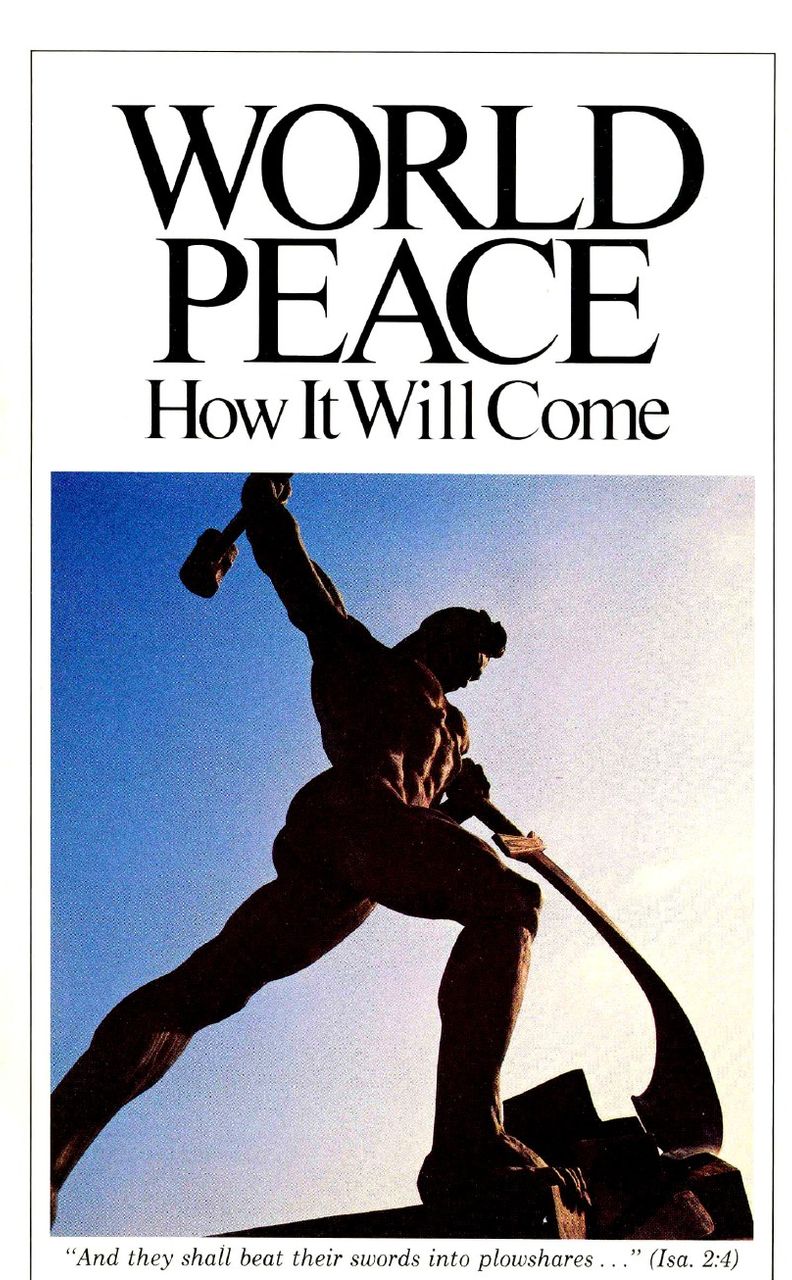
World Peace - How It Will Come
Herbert W. Armstrong’s World Peace—How It Will Come declares that lasting peace cannot be achieved by human governments but will only come when Jesus Christ returns to establish the Kingdom of God as a literal world-ruling government.
| Published: January 1, 1978
World Peace - How It Will Come
Herbert W. Armstrong’s World Peace—How It Will Come declares that lasting peace cannot be achieved by human governments but will only come when Jesus Christ returns to establish the Kingdom of God as a literal world-ruling government.